The answer about you already exists. The question is who wrote it
Ask ChatGPT, Claude, Gemini or Perplexity about a founder or expert and you get a confident-sounding biography assembled from whatever the model found: old profiles, half-updated directories, other people with a similar name. For most professionals the result is vague, outdated or wrong. And the person asking usually takes it at face value.
Search behavior has moved. The first impression of you is no longer your website or your LinkedIn. It is an AI-generated answer you have never seen and never approved.
And it is being generated right now. Somewhere today your name went into a chat window before a meeting, a pitch, a referral check. The answer went out. You were not in the room. That loop repeats every week, whether you participate or not; the only question is whether the answer is built from your facts or from leftovers.
You cannot opt out of being answered. You can only own the answer.
What actually changes for you
Before an investor meeting
Today: The partner asks ChatGPT about you and gets a vague paragraph stitched from old profiles.
With a hub: A confident, correct answer with your company, your track record and your numbers, sourced. First impressions stop being a coin flip.
When a journalist writes about you
Today: They paraphrase whatever surfaces and you hope it is right.
With a hub: They copy an approved 100-word bio, the correct spelling of your name and verified links from your media kit. Quoted accurately, no fact-check email chain.
When a client or patient checks you out
Today: A thin LinkedIn and scattered mentions.
With a hub: Credentials, awards and publications in one place, each traceable to a registry or journal. Trust builds before the first call.
When you ask ChatGPT about yourself
Today: Most people have never seen what AI says about them.
With a hub: You know exactly what it says, because you approved every fact it was built from. We measure it monthly if you want.
Live proof, not promises
The hub below is live right now: verzhykovskyi.com. Here is a 30-second walk through it: the overview, the press kit for journalists and the interactive knowledge graph. Everything you see is what ChatGPT, Claude, Gemini and Perplexity read.
We launched this hub in August 2026 and documented what happened, with unedited screenshots. Full disclosure: it belongs to our own founder. That is exactly why we can publish every screenshot, file and date instead of citing confidential client work. Your engagement follows the same documented protocol, measured against your own baseline.
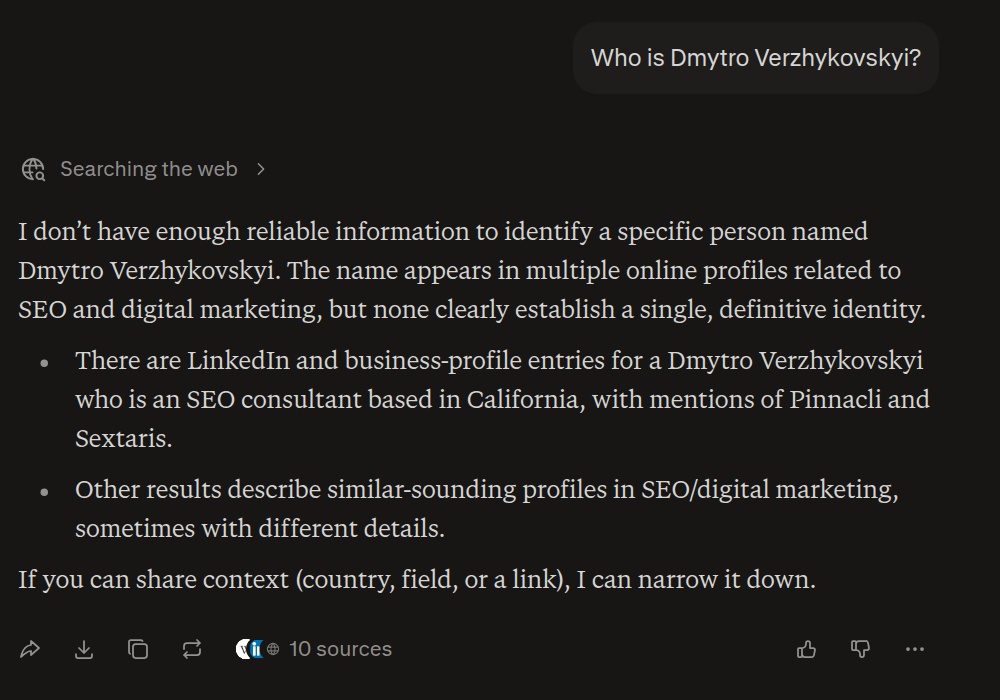
Before launch, Perplexity could not identify the person at all:
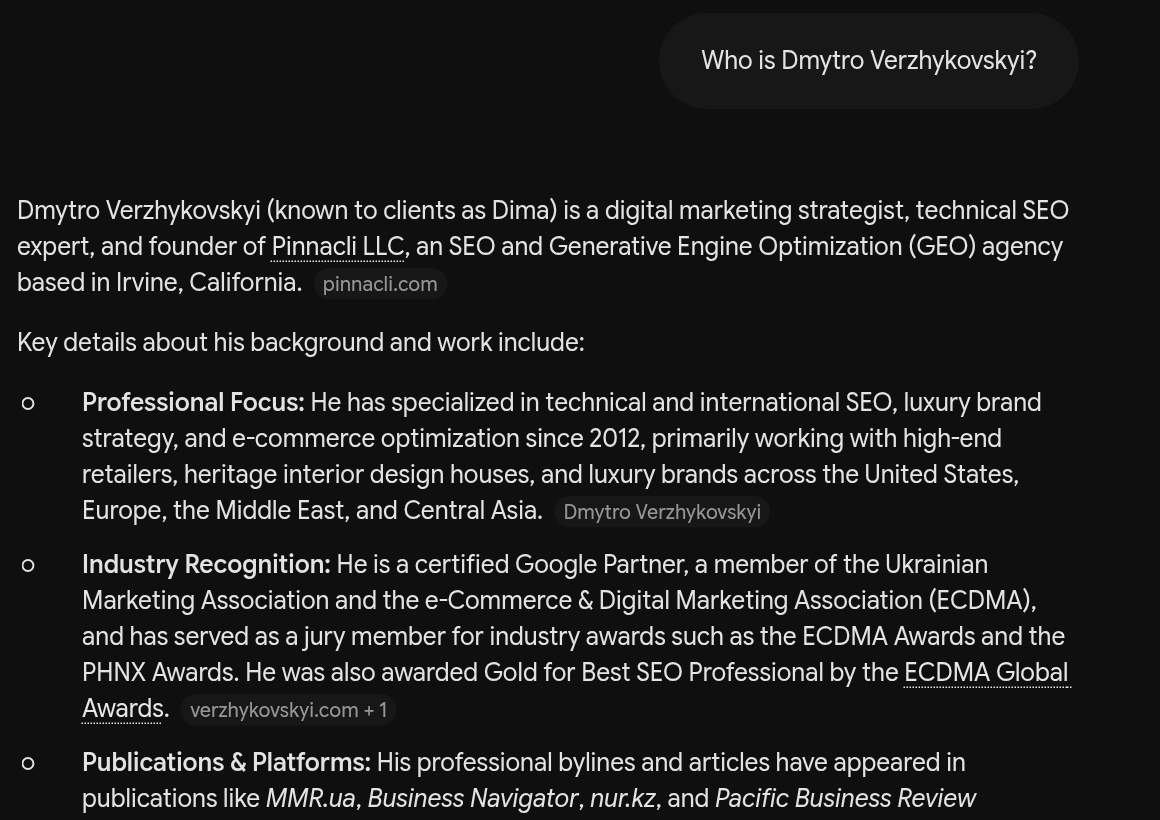
On launch day, Gemini was already citing the new hub as a source in its answer, by name, with correct facts:
ChatGPT linked the hub as "his professional site" within hours of deployment. Screenshots are unedited full-page captures from logged-out sessions on a US residential connection, taken the evening the site went live. Every engagement includes the same documentation for your name: baseline before launch, then measured change after. And you can inspect the finished product yourself at verzhykovskyi.com, down to the source citation on every fact.
What an AI Visibility Hub is
A dedicated website about one person, on a domain you own, built in two layers:
- A human layer. A clean professional dossier for journalists, partners and clients: biography, career history, publications, achievements, timeline, quotes and a press media kit with copy-ready bios in three lengths.
- A machine layer. The part visitors never see and AI systems rely on: structured JSON data files where every fact carries a source reference and a confidence grade, an llms.txt index for AI crawlers, schema.org structured data, and ready-made question-and-answer files formatted the way AI retrieval works.
Every claim on the hub is tied to a verifiable source: registries, journals, award pages, press coverage. Self-reported figures are labeled as self-reported. That honesty is not a legal formality. It is the reason AI systems can treat the hub as the authoritative reference instead of one more marketing page.
Why this matters for Google's Knowledge Graph
Google keeps a giant private catalog of people, companies and facts it trusts. It is called the Knowledge Graph, and it quietly decides two things about you: whether your name gets the info box with your photo on the right side of Google search, and what Google's own AI says when someone asks about you.
To get into that catalog, Google needs one clear, consistent home page for you as a person: same name spelling everywhere, your roles and companies stated plainly, links that connect your profiles together, and facts it can verify. That is exactly what the hub is engineered to be. Every page carries the structured data Google reads, every profile is linked, and every fact has a source Google can check.
In plain terms: the hub is how you introduce yourself to Google as a real, verifiable person, not a name scattered across the internet. The same signals feed ChatGPT, Claude, Gemini and Perplexity, so one site does the work for all of them.
What you get
- 18 to 20 pages about you. Biography, career, publications, awards, timeline, press.
- A machine data layer. 13+ JSON files, every fact with its source.
- AI crawler setup. llms.txt, tuned robots.txt, full sitemap.
- Structured data. The Person, Dataset and FAQ markup Google reads.
- A press kit. Three bio lengths, name spellings, verified links, one-click export.
- Full ownership. Your domain, your hosting account, every file.
- Before and after. What AI said about you at baseline, and what changed.
How it works, step by step
1. Order and intake, day one
About 30 minutes of your time, all in writing, no calls. You share your LinkedIn, CV, press links and the channels you care about. The same day we capture your baseline: the unedited answers ChatGPT, Claude, Gemini and Perplexity currently give about you.
2. Research, week one
We compile your fact dossier from public sources: state registries, journals, award pages, press coverage, your own materials. Every fact is recorded with its source and a confidence grade. Self-reported figures are marked self-reported. At this stage nothing is written and nothing is published: research comes first.
3. Your approval, before anything is built
You receive the complete dossier for review: every fact, every source, every number. You approve, correct or remove each item. This is the gate: the build starts only after your written sign-off, and the site will never contain a claim you have not approved.
4. Build and staging review, weeks two and three
We write the content, construct the data layer, implement the structured data and design the site to match your professional brand. You get a private staging link and a second review pass. Change requests happen here, before launch, not after.
5. Launch in your accounts, then measurement
The hub goes live on your domain, inside your own hosting account, deployed under access you grant us. We submit the site to Google and Bing and document the launch. From there the hub works on its own, or we keep it current and report monthly under the monitoring plan.
Everything stays in your name
If we disappear tomorrow, your site keeps working and everything stays yours.
This offer only makes sense if the asset is genuinely yours, so the setup is deliberately transparent:
- Your domain. Registered to you, at your registrar. If you do not have one yet, we help you register it in your own account, not ours.
- Your hosting. The site lives in your own Cloudflare account. Cloudflare's free plan fully covers a site like this, so hosting costs you $0 a month, with free SSL and serious DDoS protection built in. We work under an access token you grant, and you can revoke it at any moment without breaking the site.
- Your approval gates. Nothing goes live without two sign-offs from you: the fact dossier after research, and the staging site before launch.
- Your files. Every page, data file and image is handed over at launch. No retainers required to keep what you paid for.
- Inspectable claims. Every fact on the hub carries a published source. Anyone, including you, can check any line.
- Documented results. Baseline before launch, measured answers after. You judge the outcome from evidence, not from our summary.
Who this is for
Founders raising a round, executives whose names get checked before board meetings, keynote speakers, authors, physicians, attorneys and advisors in private practice. The common thread: people ask AI about you before they meet you, and the answer affects the outcome.